
Cerebras builds computing systems and cloud infrastructure for artificial intelligence, and its latest results put a real business behind the excitement. For the quarter ended September 30, 2026, revenue reached $210.8 million, while the company recorded a $161.2 million net loss. Its balance sheet carried about $829.1 million in working-capital loans. Those figures describe Cerebras, not CBRG, the leveraged ETF that gives traders an amplified way to express a view on the company. Cerebras results, November 12
The distinction matters because the excitement and the risk sit in different places. Cerebras must turn computing demand into durable economics. CBRG must navigate the daily movement of Cerebras shares. A persuasive business story does not automatically make every instrument attached to it a sensible long-term holding.
A fresh announcement, not an invented explanation
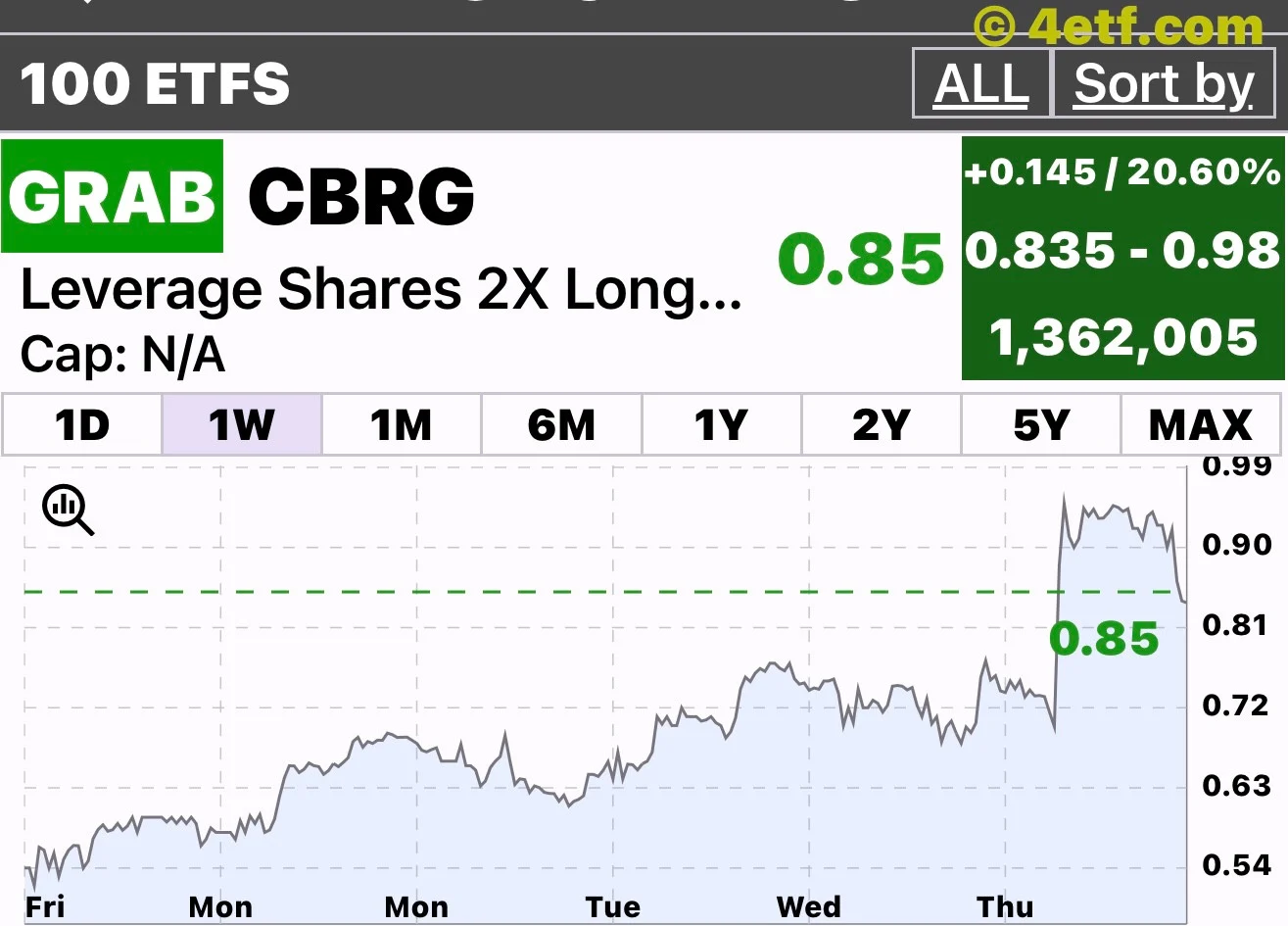
The supplied ETFon snapshot displayed CBRG at $0.85, up 20.60%. That is a screenshot observation, not a verified executable quote or a promise that the same gain remains available. The screen was supplied on November 13; its clock alone does not establish the timestamp of each underlying quote.
There is nevertheless a concrete development to investigate: Cerebras released quarterly results on November 12. Its cloud revenue climbed sharply and management lifted its outlook. That gives investors a fresh reason to reconsider the business rather than relying solely on an AI label. The timing makes earnings a credible catalyst for renewed interest, although it does not prove what caused every trade in CBRG.
The attractive part of the story is a possible transition from a technology people admire to infrastructure customers actually pay to use. The troubling part is that revenue and profitability are not interchangeable. A company can sell more while still absorbing heavy expenses, and a leveraged fund does nothing to solve that underlying financial challenge. It only changes exposure to the share price.
Why the ETF can move so dramatically
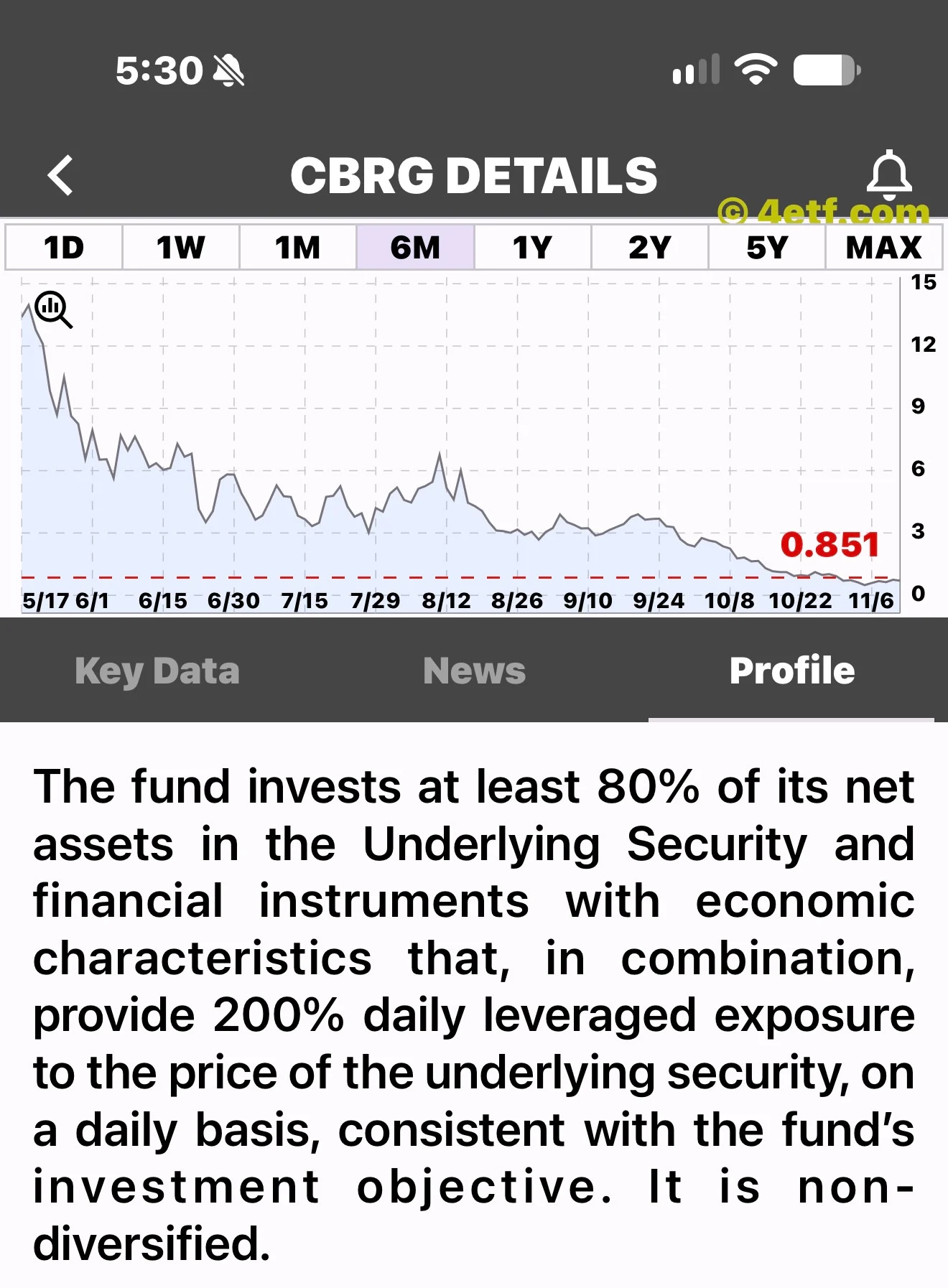
CBRG targets twice the daily performance of CBRS before fees and expenses. It does not promise twice the company's return over a month, a quarter or an entire investment journey. Leverage Shares fund description
Consider a simplified example, ignoring costs and tracking differences. A share rises 10% one day and falls 9.09% the next, returning approximately to its starting point. A perfectly tracking two-times daily product would rise 20% and then lose 18.18%. An initial $100 would end near $98.18. The underlying has gone nowhere, yet the leveraged position has lost money. That is arithmetic, not evidence that the fund malfunctioned.
The same mechanism can enhance returns during a persistent favorable trend. The problem is that an investor cannot know in advance whether the next stretch will be smooth or jagged. A convincing earnings narrative is not protection against a sudden reversal, a wide trading spread or an entry price that already reflects considerable optimism.
What would make the story stronger
The next test is not merely whether another headline includes artificial intelligence. It is whether future reports demonstrate that demand translates into cash generation, improving margins and financing needs the business can comfortably support. Forecasts should be judged against subsequent results, not treated as completed achievements.
The supplied charts add an uncomfortable counterpoint. The six-month display shows a broad decline from the mid-teens toward less than one dollar, with repeated failed rebounds. Most of the latest month remains weak in that longer view. The one-week chart, however, rises from roughly the mid-$0.50s, jumps toward the mid-$0.90s and then pulls back toward $0.85. That is a sharp rebound inside a longer decline, not proof that the downtrend has ended. The long-chart label of $0.851 and the quote-card rounding to $0.85 are consistent to the displayed precision; exact total returns require adjusted price and distribution data.
A fresh announcement provides a plausible earnings-driven explanation for attention, while daily leverage explains why the ETF can exaggerate a share-price move. The improvement deserves attention, but the longer history argues against confusing one exciting week with a completed recovery.